I Never Once Cleaned My Camera Lens
Not once. In years of filming. Never cleaned the lens.
I propped my phone up in a cabinet full of random pillows — a mirror cabinet I'd inherited with the storefront space — and I filmed try-ons with my hand over the lens to start and stop the video. No tripod. No ring light. No plan. Just me, the store, and whatever I happened to be wearing that day.
For the first stretch it was pure chaos. Random posts. Random locations. Trend dances and product shots and going live to audiences of eight people. Throwing paint at the wall and calling it a strategy.
And then the pandemic hit.
We were in and out of lockdowns and my customers were stuck at home, scared to come in, not knowing if it was safe. They wanted clothing but couldn't browse. They were isolated and anxious and quietly going a little stir-crazy.
Then one day a customer sent me a DM. She listed the pieces she was interested in and asked if I could try them on for her so she could see how they looked on a real body before making the trip.
So I did.
I went on Stories and tried them on and talked to her like she was in the fitting room with me — about how the fabric felt, how the sizing ran, whether it worked for a short waist or a fuller hip. Real talk. The kind of conversation that happens when you trust each other.
She wasn't the only one watching.
The response was immediate. Other women started showing up. Asking questions. Requesting pieces. Tuning in the next day to see what we'd try on. Messaging when I missed a day asking if everything was okay. Driving an hour to come try on the dress they'd watched me put on three times that week.
That single DM became the Daily Try-Ons.
Once we had the proper setup — a tripod, a DSLR, a shotgun mic — we stopped propping phones in cabinets and started filming properly. We tried a backdrop first. Looked professional. Had zero character. It felt like we were pretending to be something we weren't.
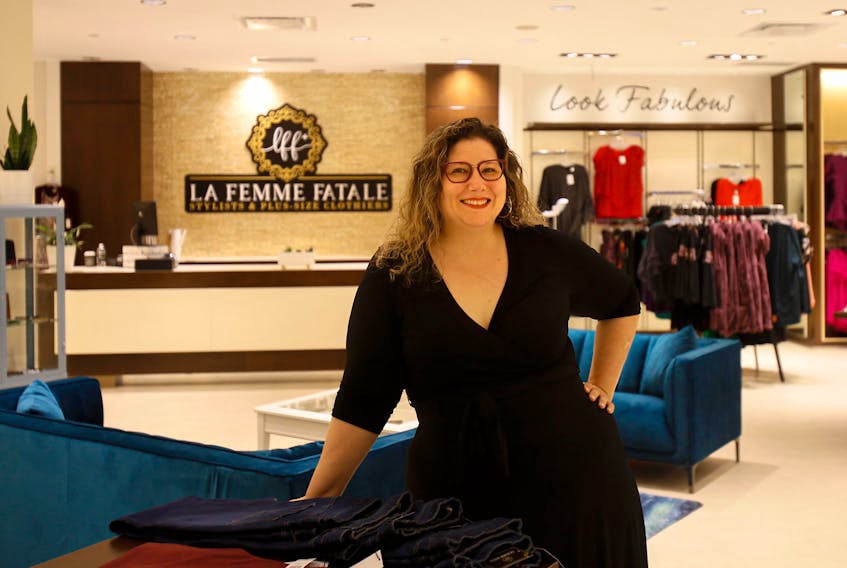
So we went back to the store itself. Because the store had a living room — two teal couches, end tables, plants — and that living room had been there from the very beginning. It wasn't a backdrop. It was the soul of the space.
That's what content style is. Not your logo. Not your font. Not even your colors — though those matter too. It's the visual and emotional signal that tells someone "this is her" before they've processed a single word.
What Content Style Actually Is
Most people think content style is about aesthetics. Pick a color palette, choose a filter, buy a ring light.
It's not. Those are tools. Content style is the decision about how you show up — and the commitment to showing up that way every single time.
It has two layers that work together — what I call The Content Style Blueprint — and you need both before your brand will feel consistent anywhere it shows up.
The visual layer is what people see. Your recurring location. Your consistent colors and fonts. The way your video covers look. Whether you're always on camera or always off it. Whether your content is bright and airy or moody and intimate. The specific corner, the specific couch, the specific window that becomes so associated with you that it functions as a logo.
The tonal layer is what people feel. Are you teaching or entertaining? Vulnerable or polished? Conversational or authoritative? Do you talk like you're having coffee with a friend or like you're presenting at a conference?
Both layers need to be consistent. Both layers need to be documented. And they need to match each other — because a brand that feels warm and personal in video but looks corporate and formal in graphics creates a low-level distrust that people can't name but absolutely feel.
Here's what inconsistency actually costs you. Every time someone lands on your page and the content looks different from what they saw before — different fonts, different lighting, different energy — they have to recalibrate. They have to re-decide whether they trust you. And most of the time they don't consciously notice they're doing it. They just quietly lose confidence and move on.
Consistency eliminates that recalibration. When everything looks and feels the same, people stop deciding and start trusting.
The Teal Couch Principle
The teal couch wasn't an accident. It was one of the first intentional decisions I made for Incandescent.
When I was planning the store, I knew I wanted a couch. Not for decoration — for purpose. I wanted customers to feel like they were in a safe and comfortable space, somewhere they could sit and breathe and not feel the pressure of a typical retail environment. I originally wanted navy velvet because navy speaks to truth and honesty. It felt right for a space built on the promise of making women feel genuinely seen.
Then I was shopping for furniture and found these gorgeous teal couches. That rich, vibrant colour. The same warmth and depth as navy but with a life to it that felt exactly right for the energy we were building. I knew immediately.
So the teal couch was always there. It was always part of what Incandescent was supposed to feel like.
What I didn't plan was that it would become our visual anchor on social media.
That happened organically. Once we had the proper setup — the tripod, the DSLR, the shotgun mic — we stopped filming in front of generic backdrops and started filming in the actual living room of the store. The most natural, most Incandescent place in the whole space.
And slowly, without us designing it, the couch became the signal.
Women would find us through a video. They'd watch it, follow, start watching more. After a few weeks the couch had just become part of what Incandescent looked like. Then an influencer partner would film a try-on — different person, different face, different voice — but the same couch in the same corner.
And the comments would say: "Oh this must be Incandescent!" before the person even introduced themselves.
That's brand recognition. Not from a logo. From two teal couches and a living room that was chosen with intention, designed with purpose, and filmed in front of consistently enough that it became the visual shorthand for everything we stood for.
The lesson isn't "find a colourful couch." The lesson is that your visual anchor doesn't have to be manufactured. It's usually already there in the decisions you made about your space, your style, and what you wanted people to feel — two couches, end tables, plants, the whole living room you built because you wanted women to feel at home. You just have to show up in front of it consistently enough that your audience starts to rely on it.
Now I film my morning content for Downey & Co. in my solarium. Plants everywhere. Natural light. The same corner every time. Not because I planned a visual anchor — because it's where I like to be, so it's where I consistently show up. And now people who follow me know that space. They expect it.
Here's how you know your visual anchor is working: your audience notices when you're not in your usual place.
The Personal Style Decision
Before you can have a visual anchor, you need to make the style decision that everything else hangs from.
Are you personal — on camera, face forward, sharing the real behind-the-scenes of your business and life? This builds the fastest trust because people feel like they know you. It's the style I use and the style that built Incandescent.
Are you professional — polished, curated, every frame intentional? This works for brands where authority matters more than relatability. It requires more production but creates a specific kind of credibility.
Are you faceless — all about the work, the products, the process, without you in frame? This works if you're building a product brand or a resource business where the content matters more than the creator.
Are you educational and visual — whiteboard style, talking-head teaching, screen-recorded tutorials? This works for service businesses where expertise is the whole value proposition.
There's no wrong answer. The wrong answer is not deciding — which means you end up cycling between all of them depending on your mood, and your audience never knows what to expect.
Decide. Document it. Commit to it.
The Cost of Never Writing It Down
Here's the thing about Incandescent that I've already told you: I never wrote any of this down.
I knew our brand in my bones. I knew the teal couch was our anchor. I knew the warm, personal, unpolished energy was our style. I knew we never used cold overhead lighting or stiff posed photography. I knew all of it.
But I never put it on paper.
So every time someone new touched our brand — a photographer, a design student helping with graphics, an influencer partner — they had to guess. And when they guessed wrong, I had to fix it. Manually. Every time. By explaining from scratch what Incandescent looked and felt like.
Compare that to what we built for Raven Heart Tarot.
Before Jocelyn posted a single piece of new content, we documented everything. Her colors — Royal Sage blue, gold, pink, crimson, white. Her fonts. Her imagery style — moody, intimate, empowering. Her tone of voice. Her visual signature. All of it in one document that anyone who touches her brand can reference before they create anything.
Now when someone sees her content — a Reel, a blog post, an email — they recognize it without reading her name. It looks like a brand. Because it is one.
The documentation isn't the creative work. The documentation makes the creative work scalable.
The Style Stack: What Needs to Be Documented
Your content style documentation doesn't have to be a 50-page brand bible. It can be a single Canva document, a Google Doc, a voice note you transcribe. What matters is that it exists outside your head.
The Style Stack has five layers — and you need all five before you can hand your brand to anyone else:
Your visual anchor — the recurring element that makes your content immediately recognizable. Your teal couch. Your solarium. Your specific desk corner. Your consistent background color. Whatever it is, name it and use it every time.
Your on-camera style — are you always visible or never? Always talking to camera or always voiceover? Always in natural light or always in your branded setup? Decide and document.
Your static content look — the fonts, colors, and layout style for your graphics, your Reel covers, your story templates. Everything should feel like it came from the same place.
Your tone in writing — how do your captions sound? What do you always say? What do you never say? What's the energy — warm teacher, sharp strategist, relatable friend, all three?
What you would never do — this is underrated. Knowing what's off-brand is as important as knowing what's on-brand. Never airbrushed. Never corporate stock photos. Never stiff formal language. Never posting without a human element. Whatever your nevers are, write them down.
The Content Style Check-In
Answer honestly. No one's watching.
Your visual anchor:
☐ I have a recurring visual element my audience would recognize across my content
☐ Someone who's watched ten of my videos could describe "my spot" without prompting
☐ I show up in the same location (or with the same visual signature) consistently — not just when I remember to
☐ My visual anchor was a choice, not an accident — I know why it works for my brand
Your style decision:
☐ I've consciously chosen personal, professional, faceless, or educational — not cycling between them
☐ My current style is something I can sustain — it doesn't require more production than I can consistently deliver
☐ My audience knows what to expect when they click on my content
☐ I can explain my style decision in one sentence if someone asks
Your static and video consistency:
☐ My graphics and written content look like they came from the same brand as my videos
☐ My fonts, colors, and layouts are consistent across platforms — not reinvented every time
☐ Someone who found me through a Reel and then visited my website would feel like they'd landed in the same place
☐ My content doesn't look dramatically different from week to week
Your documentation:
☐ My content style exists outside my head — written down somewhere someone else could reference
☐ I could hand my brand to a designer, VA, or collaborator today without explaining from scratch
☐ I have a list of what I'd never do — my hard limits are documented, not just instinctive
☐ My documentation covers all five layers of the Style Stack
Count your checkmarks:
12–16 checked: Your content style is built and documented. Your job now is to protect it — and hand it off confidently when it's time to get help.
8–11 checked: You have instincts but not a system. The visual anchor might be there; the documentation isn't. That gap costs you every time someone new touches your brand.
4–7 checked: Your style exists in your head but not on paper. You're recreating it from scratch every time you create — and so is anyone who helps you. Start with the Style Stack and document what you already know.
0–3 checked: You're in random mode — which means your audience is in recalibration mode every time they see your content. Pick one thing: find your visual anchor first, then build from there.
What This Means For You
You've done the deep work. You know who you are. You know who you're talking to. Now you have to make it recognizable.
Lesson 1: Your visual anchor is more powerful than your logo. People don't consciously register logos. They register patterns. The teal couch. The solarium. The consistent corner. Patterns become recognition. Recognition becomes trust.
Lesson 2: Consistency isn't about frequency — it's about predictability. You don't have to post every day. You have to look and sound the same every time you do post. Predictability is what builds the feeling of familiarity. And familiarity is what makes people buy.
Lesson 3: Your tonal style is as important as your visual style. If your videos feel warm and personal but your captions sound like a corporate newsletter, you're creating cognitive dissonance. Every touchpoint should feel like the same person made it.
Lesson 4: The Style Stack isn't optional once you want help. The moment you bring in anyone else — a designer, a VA, a photographer, a content creator — you need all five layers documented. Build it before you need it, not when you're scrambling to fix what they got wrong.
Lesson 5: You probably already have a style. You just haven't named it. Most solopreneurs have an instinctive way of showing up that their audience already responds to. The work isn't creating it from scratch. It's noticing what's already working, naming it, documenting it, and protecting it.
I never cleaned my camera lens. I propped my phone in a cabinet full of random pillows and filmed try-ons for audiences of eight people and had absolutely no idea what I was building.
But I showed up in the same store, in front of the same couches, with the same energy — every single time. Not because I had a content style document. Because it was just where I was and who I was.
And eventually, people could recognize Incandescent before they even read the name.
That's what's available to you. Not a manufactured brand identity you have to perform. The version of your business that already exists — named, documented, and protected so it can keep working even when you're not the one creating.
Your audience is already looking for the pattern. Give them one worth finding.