I Cried in a Dressing Room Once
Not because something fit.
Because nothing ever did.
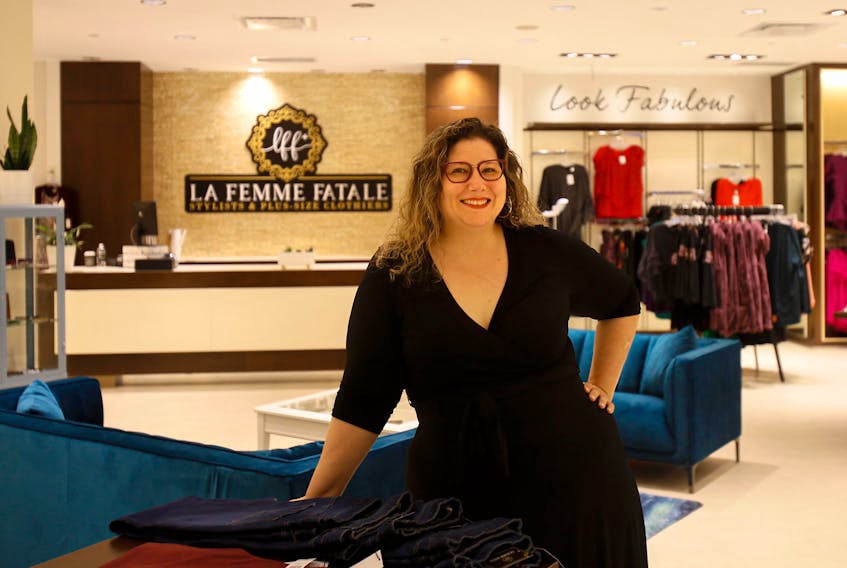
I was a plus-size woman in Halifax trying to find something to wear to an event that mattered. I went to three stores. I left empty-handed from all three. And sitting in the parking lot of the last one, I gave myself the little speech I'd given myself a hundred times before — the one where you tell yourself it's fine, you'll find something, it doesn't matter.
It mattered.
That moment became a business plan. Pages 1 through 28 of it — before we even got to the social media section — were about that feeling. About the women who lived it every time they walked into a store. About what it would mean to build a place where that feeling didn't exist.
In 2019 I wrote this in my business plan for La Femme Fatale Plus-Size Clothiers:
"We know that buying clothing as a plus-size woman is challenging. Having cried out of frustration in the dressing room myself..."
Raw. Personal. Completely unpolished.
By 2024 — five years later, a rebrand, a pandemic, and a completely rebuilt digital strategy behind me — the same core truth had become this:
"At Incandescent, we believe every woman deserves to walk into a room and own it. We exist to help women of every shape and size discover the clothes — and the confidence — that make them shine. Because when a woman feels truly beautiful in what she's wearing, she doesn't just look radiant. She becomes it."
Same heart. Different documents. Exponentially more clarity each time.
Here's what I learned from watching that evolution happen in real time: the mission statement you write on day one will not be the mission statement you need on day five hundred. But you still have to write the day-one version. Because refinement only happens when there's something to refine.
That's what Foundation 1 is about. Not getting your brand identity perfect. Getting it documented — so you have something to build from, something to hand to collaborators, something to return to when you lose your way.
What Brand Identity Actually Is
Most people think brand identity is their logo and their colors.
It's not. Those are brand assets. Brand identity is what those assets are supposed to communicate.
Your brand identity is the full picture of who your business is — how it thinks, how it sounds, how it looks, and why it exists. It's the difference between someone seeing your content and thinking "that could be anyone" versus "that's definitely her."
It has four components. And you need all four before any of your content, your channels, or your strategy will hold together.
Your Digital Mission Statement. Why you show up online — the transformation you provide, the people you serve, the change you're trying to make in the world through your digital presence.
Your Unique Value Proposition. Why someone chooses you over every other option — not your features, your transformation. Not what you do, what changes for someone because you did it.
Your Brand Archetype. The personality that shapes how you show up — your tone of voice, the stories you tell, the emotional experience people have when they encounter your brand.
Your Visual Identity Documentation. The written record of what your brand looks like — colors, fonts, imagery style, the recurring visual elements that make you instantly recognizable before anyone reads a word.
Let's build each one.
Component 1: Your Digital Mission Statement
Here's what most people get wrong about mission statements: they write their business mission statement and call it done.
Your digital mission statement is different. It's not about what you sell. It's about why you show up online. The transformation your digital presence creates. The people you're building it for.
The question it answers isn't "what do I do?" It answers "why does my online presence exist?"
Watch how mine evolved:
2019 — La Femme Fatale Business Plan:
Hyper-local. Retail-first. Emotionally raw. The focus was the in-store experience — a physical space where plus-size women in Halifax could shop without the parking lot pep talk. The digital presence was an afterthought. Pages 29–36.
2024 — Incandescent Digital Strategy:
Brand-polished. Digitally expansive. Community-oriented. "Redefine the fashion industry." "Celebrate beauty and diversity." The personal "why" was still there — it just got translated from a founder's raw story into a brand's strategic identity.
Now — Downey & Co.:
"We believe in the power of women entrepreneurs. We're passionate about creating a world where women feel empowered to build thriving businesses that reflect their unique talents and passions."
Same heart. Three completely different expressions of it. Each one more refined because the previous version existed to be refined.
Here's the formula:
We exist online to [transformation you provide] for [specific people you serve] so they can [ultimate outcome they achieve].
That's it. Two or three sentences. Specific enough that you couldn't swap your business name with a competitor's and have it still work. Honest enough that it actually sounds like you wrote it.
Your turn: Write three versions. Ugly first drafts. Don't edit while you write. Just get it out.
The right version will feel like relief when you read it back.
Component 2: Your Unique Value Proposition
Why you? Why not your competitor?
Not "I'm cheaper." Not "I'm better." The specific transformation you provide that no one else provides in quite the same way.
Here's where I got it wrong for years.
I thought my UVP was "cute plus-size clothes at good prices." That's not a UVP. That's a feature. Every boutique has clothes at some price. Features are what you have. Your UVP is what changes for someone because they chose you.
My actual UVP — the one I didn't articulate until we were nearly done — was this:
"We teach you how to dress your body with confidence."
Not selling clothes. Teaching confidence.
That shift changed everything. It changed my content — because suddenly I wasn't posting product shots, I was posting education. It changed my customer service — because my staff wasn't selling, they were styling. It changed my entire relationship with what we were actually building.
The formula:
I help [specific people] achieve [specific outcome] through [your unique approach] so they can [ultimate transformation].
Example from Downey & Co.: "I help women solopreneurs build digital strategies that actually work for their real businesses through personalized mentoring and frameworks born from real experience — so they can stop guessing and start building something sustainable."
Here's the test: Could you swap your business name with your competitor's and have your UVP still work? If yes, it's not unique enough. Keep going.
Write five versions. Test them on people who know you. Watch which one makes them say "yes, that's exactly what you do."
Component 3: Your Brand Archetype
Here's what I want you to understand about brand archetypes before we go any further.
I knew mine before I wrote a single caption for Downey & Co. Before I built the website. Before I wrote the first blog post. Before I posted anything on Instagram.
Not because I'm exceptional at self-awareness. Because I'd spent five years in the trenches of a boutique that taught me exactly who I was — as a business owner, as a teacher, as someone who shows up for people when things are hard.
Every day I kept Incandescent open was another day of figuring out how to connect with women who felt invisible. How to teach without preaching. How to be honest about struggle without making it someone else's problem to fix. How to hold expertise lightly enough that the person across from me felt capable rather than talked at.
By the time the boutique closed I knew something I couldn't have known any other way: I was The Authentic Mentor. A blend of The Sage, The Caregiver, and The Everyman. Someone who teaches from experience not theory, who walks the path with you instead of pointing at the mountain, who cares whether you actually make it — not just whether you bought the thing.
That clarity is the reason Downey & Co. has felt coherent from day one. The reason the voice is consistent. The reason the content has a throughline even when the topics change.
Your brand archetype is the personality framework that makes all of that possible. It determines how you sound, what stories you tell, and the emotional experience people have every time they encounter your brand. When you know it — really know it, not just picked one from a list — you stop accidentally rotating between three different versions of yourself and start showing up the same way every time.
That consistency is what makes people feel like they know you. And people buy from people they feel like they know.
There are twelve archetypes. Most brands are a blend of two or three. Here are the most common ones for solopreneurs:
The Sage — wise guide, expert, trusted teacher. Leads with knowledge. Builds authority through education.
The Caregiver — nurturing, supportive, protective. Leads with empathy. Builds trust through genuine care.
The Everyman — relatable, honest, unpretentious. Leads with authenticity. Builds connection through shared experience.
The Hero — empowering, driven, transformative. Leads with challenge. Builds inspiration by helping others rise.
The Rebel — disruptive, honest, rule-breaking. Leads with truth. Builds loyalty by saying what others won't.
The Creator — innovative, visionary, original. Leads with ideas. Builds following through distinctive perspective.
Here's a quick way to find yours. Answer these three questions honestly:
When you create content, do you naturally lead with expertise (teaching, frameworks, insights), empathy (understanding, support, care), or relatability (shared experience, honesty, "me too" moments)? That's likely your primary archetype — Sage, Caregiver, or Everyman respectively.
When you read back your best-performing content — the posts that got the most saves, the most DMs, the most "this is exactly me" responses — what do they have in common? That emotional quality is your archetype already at work.
Think about the hardest thing you've been through in your business. How did you show up in that moment — as the expert who found the solution, the caregiver who held it together for everyone else, or the everyman who just kept going honestly? That's your core.
Give your blend a name. Not a marketing name — just a descriptor that reminds you who you are when you sit down to create. Because the goal isn't to perform an archetype. It's to finally stop performing and just be the thing you already are.
Component 4: Your Visual Identity Documentation
This is the one everyone skips. And it's the one that costs the most when you skip it.
Visual identity documentation is not your logo. It's the written record of every visual decision your brand has made — so that anyone who touches your brand, at any point, can make it look like you without having to ask.
Here's what it includes:
Colors — not "teal and gold." Exact hex codes. Which color goes where. What you never put together. The proportions.
Fonts — your headline font, your body font, your accent font if you have one. Where each one lives. What sizes.
Logo usage — which version of your logo goes where. What you never do to it. Minimum sizes. Clear space rules.
Imagery style — what your photos look like. The mood. The lighting. What you'd never use. Real examples of on-brand vs off-brand.
Tone of voice — how you sound in writing. Your signature phrases. What you never say. Examples of captions that are you and captions that aren't.
Visual signature — your recurring anchor element. For Incandescent it was the teal couch. For Downey & Co. it's the solarium. The thing that makes someone recognize you before they read your name.
I never documented any of this for Incandescent. I kept it all in my head. And every time I brought someone in to help — a photographer, a designer, a social media assistant — I had to start from scratch explaining what our brand looked and felt like.
We did it properly for Raven Heart Tarot. Royal Sage blue, gold, pink, crimson, and white. Specific fonts that felt magical but readable. A clear imagery style — moody, intimate, empowering. All of it written down in one document.
Now when someone sees her content anywhere — a Reel, a blog post, an email, her website — they recognize it before they read her name. That's what documentation does. It turns a vibe into a brand.
Even a one-pager. Even a simple Canva document with your colors and fonts and a few example images. Anything is better than keeping it in your head.
Document it. Then share it with everyone who touches your brand. Then update it as you grow.
Are You Building a Brand or Just Posting?
Here's the honest check-in. Answer these four questions:
Mission: If someone asked you right now why your business exists online — not what you sell, but what transformation you provide and for whom — could you answer in two sentences without hesitating?
UVP: Could you explain why someone should choose you over your competitor without mentioning price, without mentioning features, and in a way that only your business could claim?
Archetype: Do you know the emotional experience you're trying to create when someone encounters your brand? Does your content consistently create that experience?
Visual Identity: Could you hand someone a document tomorrow that tells them exactly what your brand looks and sounds like — so they could create something on-brand without asking you a single question?
If you hesitated on any of those — that's your starting point.
Not a judgment. A direction.
What This Means For You
If you're reading this thinking "I've been posting for two years and I couldn't answer most of those questions" — I want you to hear something important.
You're not behind. You're exactly where most solopreneurs are. The difference between you and the businesses that look effortlessly cohesive online isn't talent or time. It's documentation.
They wrote it down. That's it. They made the decisions, they wrote them down, and they followed them.
Before you download the worksheet — do this right now. Open a notes app, a doc, the back of an envelope, whatever's closest. Write your UVP in one sentence. Ugly draft. Don't edit it. Just fill in the formula: "I help [specific people] achieve [specific outcome] through [your unique approach] so they can [ultimate transformation]."
It will be wrong. That's fine. Write it anyway. Because that wrong first version is the thing you're going to refine. And you cannot refine nothing.